
Coolabah’s Christopher Joye says Australia is becoming one of the world’s least attractive places to invest. Here’s how he’d turn it around.
Anyone paying even a modicum of attention to the fallout of the federal budget’s tax changes will be aware of the extreme backlash from the business world.
Similar to the franking credit battle of 2019 or the more recent outrage over the attempt to tax unrealised gains in high balance super funds, the response to the CGT and negative gearing reforms was swift and vociferous.
Coolabah Capital’s Christopher Joye is among the high-profile investors that have taken aim at the Labor government for, in his words, “sucking furiously on the taxpayer teat”.
While some detractors have centred their arguments on how effectively the measures are going to achieve the government’s goals, Joye instead says the mission should be making Australia “the best place in the world to start a business and to invest”. Moreover, he’s got pointed list of ingredients he believes can help to arrest the country’s slide;
- Redesign the tax system; radically reduce income taxes, radically reduce business taxes, fund that with a higher GST
- Reduce public spending, particularly the NDIS; “I’d take a knife through the entire public service, slash a quarter out of that”
- Sell the NBN; there’s a risk it becomes worthless due to Starlink
- Create an CGT exemption for business owners up to $50 million: “If you start a business in Australia – not just the owners, you and your employees – if you own shares in that business, will get a complete exemption from all capital gains tax liabilities up to a threshold of $50 million per person”
These changes, argues Joye, would help to address his assessment that Australia is “right now, amongst the worst [places to invest].”
“What Australia needs to understand and what these professional pollies need to get through their heads is we’re competing for the best brains, the best business and capital with everyone else in the world; with the US, Europe, the UK, China, Dubai, New Zealand. And people and capital are mobile.”
In this interview, Joye breaks down Australia’s productivity problem, what he would do if he was Prime Minister (not on the cards, he notes), and the widening gap between the US and Australia.
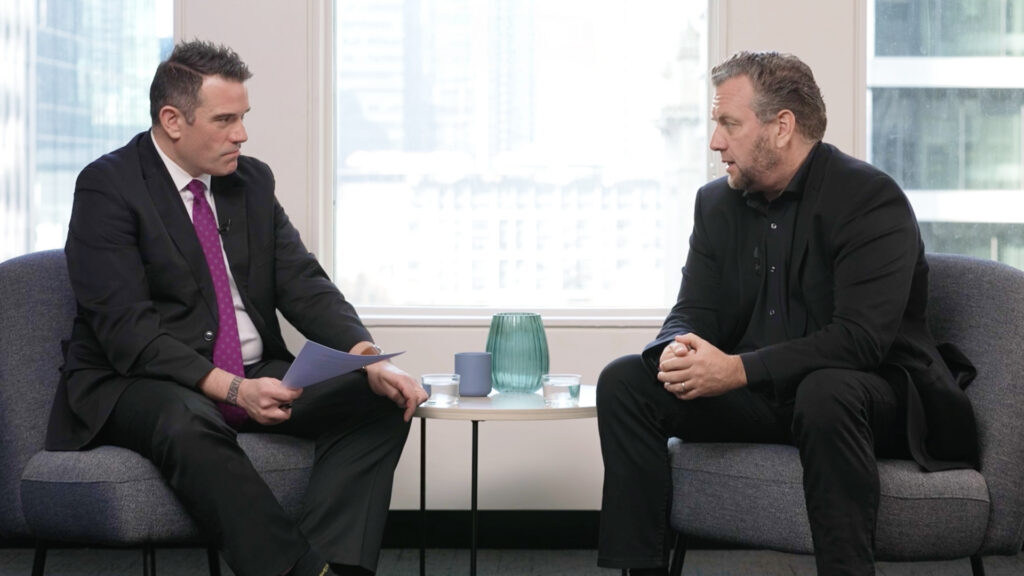
Livewire’s Chris Conway and Coolabah Capital’s Chris Joye
Lucky country or lazy land?
When it comes to the major issues facing Australia, the core issue of concern for Joye is that the country is becoming a less competitive place to invest, build businesses and create wealth.
“In Australia, we have world-beating population growth. We don’t have any problem with demand because we’ve been importing half a million foreigners every year and plonking them on the East Coast. Immigration has been driving a lot of inflation,” he says.
“The other demand and inflation driver has been public spending. We have racked up since 2007 about $1.3 trillion of extra public debt. An individual Australian at around that time in 2007 had government debt that they owed, which was worth about $6,000 per person. Now it’s circa $60,000 per person.
“So a new child born in Australia inherits immediately a $60,000 debt that they’ll pay back with their taxes over time.”
The result, he argues, is that “one in two Australians now derive more than half their income from the public purse”, while productivity growth has stalled.
“The lucky country has become the lazy land. We’re not making anything. We’re not innovating. Our entrepreneurs are heading offshore. I moved overseas last year and I think it’s sobering for these professional politicians who, you’ve got to understand, have never created any products or services in their lives,” Joye says.
“They’ve never started a business. They’ve never worked for a business. They’ve never hired a single soul from their hip pocket. These guys just see us, the private sector, as a target rich environment.”
The tax and spending fix
There’s a common adage, often attributed to Teddy Roosevelt, that says complaining about a problem without posing a solution is called whining. Under that rubric, Joye is definitely not just whining.
Instead, he lays out a radical package to reform the tax system and public spending that he believes would turn things around and drive productivity growth.
“If I were Prime Minister, which I never will be, but if I was, what I would try and do is redesign the entire tax system,” Joye says.
“Basically, radically reduce income taxes, radically reduce business taxes, fund that with a higher GST, and also fund it by shrinking the extreme and reckless political spinning that Albo has affected whereby he has expanded the size of the public service in Australia since only 2022 by 25%.”
He also floats the idea of selling the NBN, which Starlink could “eviscerate”, and slashing the NDIS.
“The NDIS should be about $15 billion per annum. So I’d cut $40 billion out of the NDIS. I’d take a knife through the entire public service, slash a quarter out of that,” Joye says.
“Then what I’d do, if you start a business in Australia, you and your employees – not just the owners – you and your employees, if you own shares in that business, will get a complete exemption from all capital gains tax liabilities up to a threshold of probably $50 million per person.”
House prices falling not as bad as the process
Turning to housing, Joye argues that falling prices aren’t inherently a problem, but the way the government has gone about it is.
He points to Coolabah’s modelling, which suggests the government’s negative gearing changes could reduce national house prices by as much as 9%, describing the changes alongside recent rate rises as “a double tap on the housing market”.
“They deliberately misled the public, lied to the public circa 50 times with respect to CGT, negative gearing, and of course trusts,” Joye says, noting that Labor lost the 2019 election on “effectively the same platform”.
“It’s ostensibly a subversion of democracy because they’re actively misleading and manipulating voters.”
Looking ahead, Joye expects the Reserve Bank will need to raise rates another two to three times as inflation remains stubbornly above target, driven by both immigration and public spending.
“I think coming into the 2028 election, what’s going to happen is Canberra won’t be able to help themselves. They’ll just keep on spending like drunken sailors because they’ll see a weakening economy and they’ll want to support the economy.”
The US comparison
Joye also pushes back on what he sees as an overly simplistic Australian view of the Trump administration, arguing that regardless of political allegiance, the business environment in the US has genuinely improved.
“If you want to get shit done in the US, you can,” he says, pointing to falling unemployment, tax cuts, and deregulation as evidence of a system oriented toward supporting entrepreneurship rather than constraining it.
“We’ve argued for a year that AI will be inflationary, not deflationary. We’ve argued that AI will create jobs, not destroy jobs. We’ve argued that the US economy is going to be much stronger than people think because of Trump’s $4 trillion of tax cuts, because of the fact that the Fed cut rates from 5.25-5.5% down to 3.6%, and also because of the reassuring of strategically important supply chains.”
He also flags an expectation the Federal Reserve will need to raise rates materially after the November midterms, a view he says runs counter to market consensus.
“I think there is a deal with Trump to try and basically delay, delay, delay. But after the midterms, it’s game on. And I think it’s sobering to think how will US equities, US private credit and other parts of the economy react to a hiking cycle?”
So, what should Australia learn from the US?
“Promote entrepreneurs rather than seeking to handicap and punish them.”
Disclaimer: This information is suitable for wholesale investors only and has been produced by Coolabah Capital Institutional Investments Pty Ltd ACN 605806059, which holds Australian Financial Services Licence No. 482238 (CCII). The views expressed in this recording represent the personal opinions of the speakers and do not represent the view of any other party. The information does not take into account the particular investment objectives or financial situation of any potential listener. It does not constitute, and should not be relied on as, financial or investment advice or recommendations (expressed or implied) and it should not be used as an invitation to take up any investments or investment services. Whilst we believe that the information discussed in the podcast is correct, no warranty or representation is given to this effect, and listeners should not rely on this information when making any decisions. No responsibility can be accepted by CCII to any end users for any action taken on the basis of this information. Any performance data presented on this site is pre-fees for institutional clients that negotiate custom fee rates, and these solutions are not available to retail investors. No investment decision or activity should be undertaken without first seeking qualified and professional advice. CCII may have a financial interest in any assets discussed during the podcast. Listeners in Australia are encouraged to visit ASIC’s MoneySmart website to obtain information regarding financial advice and investments.